
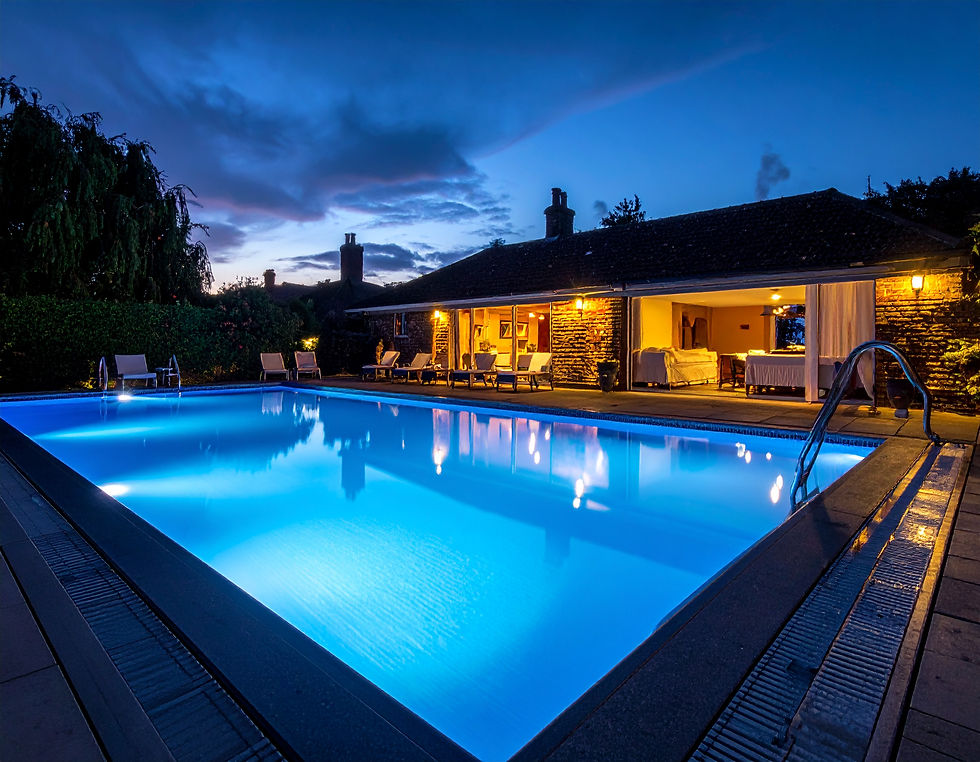
Swimming Pool Lighting in London & the South East
Light underwater : why pool lighting is a specialist discipline, not a product choice
Pool lighting appears, from the outside, to be a straightforward decision: you pick a fitting, specify a colour, and have it installed. In practice, the design of a pool lighting system involves electrical engineering in a permanently wet environment, optics, photometric calculation, control system integration, and an understanding of how light behaves differently once it enters water — and these are not problems that resolve themselves by choosing an expensive product. Light refracts when it crosses the air-water boundary: a fitting that appears to illuminate a broad arc in the air creates a different and narrower cone of useful illumination once installed beneath the surface, and its perceived brightness is affected by the reflectance of the tile surface, the turbidity of the water, and the depth of installation. A single fitting producing 3,000 lumens positioned mid-pool at 1.5m depth creates a completely different visual effect than the same fitting positioned at the shallow end wall — and that difference is not intuitive unless you have designed enough pools to have seen both. The starting point for any lighting design is a photometric layout: a calculation of the illuminance (in lux) at the water surface and at the pool floor that each proposed fitting generates from its proposed position, taking into account beam angles, refractive loss at the air-water interface, and the absorption characteristics of the water itself. This calculation is what tells you how many fittings are needed, where they should be positioned in the shell, and what wattage is required — not a product brochure.
LED technology and why it has entirely replaced traditional pool lamps
The transition from halogen and incandescent pool lamps to LED technology is now essentially complete in the professional pool sector, and the reasons go beyond energy efficiency. The fundamental advantage of LED in a pool context is longevity: a quality underwater LED module with appropriate thermal management has a rated life of 50,000 hours or more, compared with 2,000 to 3,000 hours for a tungsten halogen equivalent. In a pool fitting that must be replaced by draining the pool or using a specialist diver, this difference in service interval is commercially significant. The energy saving is equally material: a contemporary LED underwater fitting delivering 2,500 lumens draws approximately 18 to 25 watts, where the halogen equivalent required 300 watts for comparable output. For a pool with six fittings running six hours per evening, the annual energy saving of switching to LED is around 900 kWh — roughly £180 to £270 at current rates. The colour rendering capability of modern RGB and RGBW LED pool fittings has also advanced considerably: a full-colour LED fitting can produce virtually any hue across the visible spectrum, with colour coordinates controlled via DMX512 protocol or proprietary wireless systems to create static colour settings, colour-cycling sequences, or synchronised multi-fitting effects. The choice between monochrome white LED — which produces the cleanest and most natural-looking illumination and is the preference for pools where the primary function is visibility — and full-colour or warm-white options is primarily an aesthetic one, but it has installation implications: full-colour DMX-addressable systems require a controller and, typically, an additional signal cable route alongside the power circuit.
Electrical installation: the regulatory framework and why it is non-negotiable
Swimming pool electrical installations are governed by Part 7, Section 702 of BS 7671 — the IET Wiring Regulations — which defines exclusion zones around the pool and mandatory requirements for equipment selection and installation that go significantly beyond standard domestic electrical practice. The regulations define three zones concentric with the pool: Zone 0, which is within the pool itself; Zone 1, which extends to 2m around the pool perimeter and 2.5m vertically above the water surface; and Zone 2, which extends to 3.5m from the pool edge. Within each zone, specific minimum IP (Ingress Protection) ratings and equipment voltage limitations apply. Within Zone 0 — the pool interior — only safety extra-low voltage equipment operating at a maximum of 12V AC or 30V DC is permitted, and the supply to any such equipment must come from a safety isolating transformer located outside Zone 2. Pool underwater fittings must be supplied at SELV (Safety Extra Low Voltage) from a transformer outside the hazardous zone, and the transformer must be accessible for servicing without entering any zone. In addition, all metallic components in and around the pool — handrails, ladders, metal conduit, underwater fittings, and any exposed pipework — must be connected to a supplementary equipotential bonding conductor that equalises the potential between all metallic elements and prevents any stray voltage differences that could produce a shock hazard. This bonding network is tested and certified as part of the electrical completion inspection, and without a valid electrical certificate from an NICEIC-registered engineer, the pool installation is not legally complete. We execute all pool electrical work in-house to these standards and provide full certification on every project.
Feature lighting and poolscape design: the relationship between pool and garden
Underwater lighting is typically the dominant visual element of a pool at night, but it rarely exists in isolation. The broader poolscape — the surrounding deck, the planting, the pool house or outbuilding if present, any water features, and the transition into the wider garden — benefits from a coordinated lighting design that treats the pool as the centrepiece of a larger composition rather than as a self-contained object. Perimeter lighting along pool coping creates a defined boundary between the water surface and the deck, reinforces safety at the pool edge after dark, and when designed with warm-temperature sources positioned at low angles, creates the grazing effect that brings texture to natural stone and textured coping materials. Feature wall lighting in pool houses or pavilions — especially where a wall light source is reflected in the pool surface — creates a visual doubling effect that can be extraordinarily effective in enclosed outdoor rooms. Fibre optic star-ceiling systems in pool hall roofs, in which a remote light source feeds hundreds of individual glass fibre strands that terminate at the ceiling surface, have become popular in basement pool projects where the depth of the space benefits from the illusion of sky. All of these elements must be planned as a system, not assembled from a series of product choices made independently — and the control infrastructure that unifies them, whether a simple scene controller or a full DMX lighting processor integrated with the building management system, must be designed before the electrical first-fix begins.
Maintenance, access and long-term reliability
The most overlooked aspect of pool lighting specification is what happens when a fitting needs to be replaced. In a concrete-shell pool, underwater fittings are installed in niches cast or cut into the shell wall, with the cable routed through a watertight conduit to a junction box outside the pool. The fitting is retained in the niche by a stainless steel clamp ring and can, in theory, be replaced without draining the pool — the cable is sufficiently long to allow the fitting to be drawn up to the water surface for access. In practice, this cable-loop detail is frequently omitted or shortened during construction, and the first fitting replacement requires either a pool drain or a dive, neither of which is desirable at the time and both of which are avoidable by specifying the cable loop correctly in the first place. We detail all underwater fitting installations with a minimum 1.5m of service loop, routed within the conduit to the junction box and coiled at the niche face, as standard. The junction box specification is equally important: it must be waterproof to IP68, located above water level for accessibility, and positioned to allow the fitting service loop to reach it without strain. On projects where multiple underwater fittings are controlled individually via a DMX system, the junction box must also accommodate the signal cable and appropriate interface. These are the details that determine whether your pool lighting works reliably for a decade or becomes a recurring maintenance problem — and they are the kind of details that experienced pool contractors get right without needing to be reminded.